Two subscribers join your list on the same day. Both are 29-year-old marketing managers from Pune. Both signed up through the same landing page. On paper, they look like the same person.
Three months later, one of them has opened almost every email you sent and clicked through to your site four times. The other hasn't opened a single one since week two.
If you're segmenting by demographics alone, both of these people would still be in the exact same bucket, "29, marketing manager, Pune. "You'd send them the same email, at the same time, with the same offer. And you'd be wrong about at least one of them.
This is the gap that engagement-based segmentation fixes. Instead of grouping people by who they are on paper, you group them by what they actually do with your emails.
What "engagement score" actually means
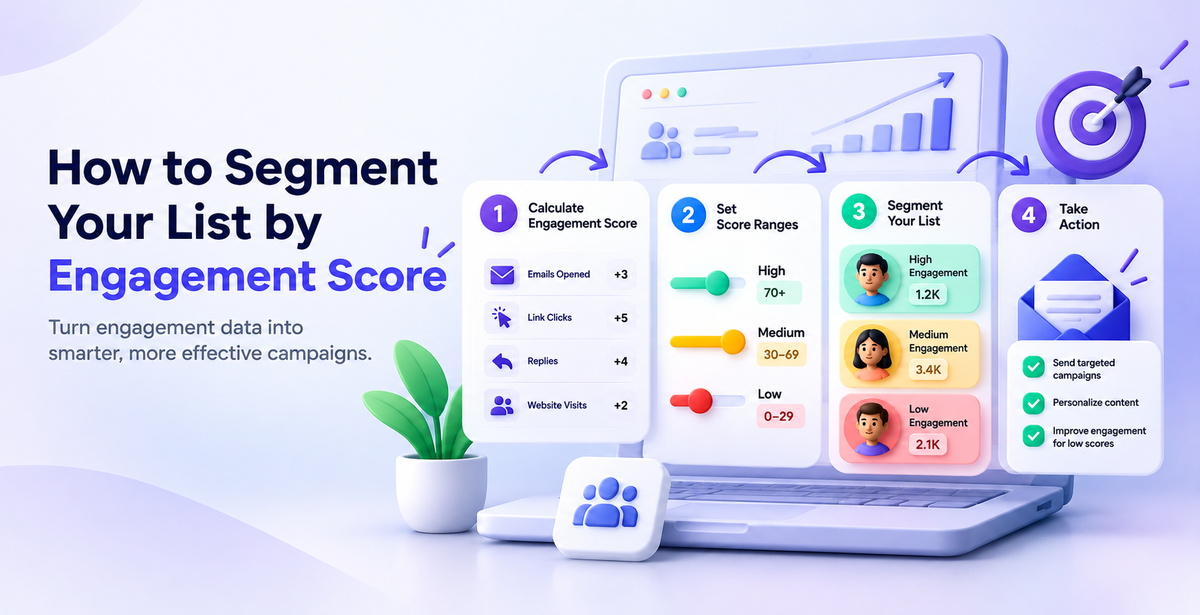
An engagement score is just a number you assign to each contact based on how they interact with your emails - opens, clicks, replies, and how recently any of that happened. A higher score means the person is paying attention. A low score indicates that they have stopped seeing you in their inboxes.
It's not a fancy machine-learning concept. Most small teams can build one with a spreadsheet, or with the tracking data their email tool already collects. Pingovo, for instance, already logs opens and clicks per contact in the campaign dashboard, so a lot of the raw material is sitting there whether you use it or not.
Demographic segmentation asks "who is this person." Engagement segmentation asks "is this person still with me." Both questions are important, but one of these questions changes from week to week - and that's the one most businesses ignore.
Why demographics alone stop working as your list grows
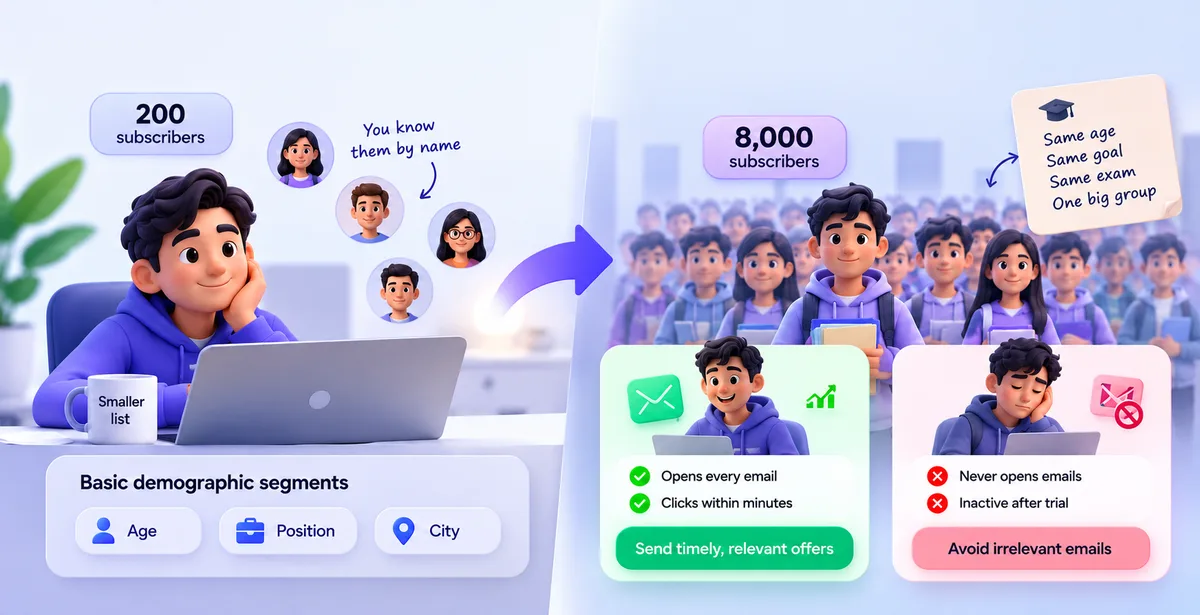
When you have 200 subscribers, you know most of them by name. Segmentation is mostly irrelevant.
At some point (usually when you pass a few thousand subscribers) most basic segments (age, position, city) stop being predictive. Take an ed-tech company selling an online exam-prep course. They might have 8,000 contacts, all students aged 18-22, all preparing for the same competitive exam. On demographics, this is one giant, uniform group.
But in this group: some open every email on mocks and click on the link within minutes. Others never open anything after the free trial. The last few seats left email is just a waste of their time (and yours) if you send it to both.
The company doesn't need a course for every age bracket. It needs a different pitch for the student who is still reading and the one who stopped reading three days ago.
What actually goes into a good engagement score
You don't need every data point available. A handful of signals, weighted sensibly, is enough.Here is what most of the engagement scores are composed of, explained simply:
Opens - whether they opened the email. This score is usually the one, on this list. It has been going down for a year now. Because of Apple's feature called "Mail Privacy Protection " it automatically loads all images in the background, on phones and computers. Emails that only show a preview are being counted as opened even if the person never actually saw the preview..So opens are useful as a rough signal, not as proof of interest.
Clicks - whether the person clicked a link inside the email. This is a much stronger signal, because it takes a real action from the reader, not just a background image load.
Recency – how long it’s been since the contact’s last open or click. A contact who clicked on a message three days ago, versus another contact who clicked five months ago would be segmented differently, even if they have the same number of total clicks.
Replies or forwards - if your emails allow for replies (support updates, personal outreach, newsletters with a "hit reply" line), a reply is about as strong a signal as you'll get.
Purchases or conversions – if the email prompted a purchase, a form fill, or a signup, that’s more important than anything else in this list.
Negative signals – unsubscribes, spam complaints and hard bounces. These are things which should reduce the score, rather than being ignored.
Building the score without needing a data team
You don't need statistics training for this. A simple points system works fine for most businesses. Here's an example, using a fictional small business to make it concrete.
Meera runs a skincare brand out of Jaipur and sends two campaigns a week - a Tuesday tip and a Friday offer. She wants to know which of her 6,000 subscribers are actually worth targeting for a new launch. She sets up a basic scoring rule:
- Clicked a link in the last 14 days: +10 points
- Opened an email in the last 14 days (no click): +3 points
- No open or click in 30-60 days: -5 points
- No open or click in 60+ days: -15 points
- Made a purchase in the last 90 days: +20 points
- Unsubscribed or marked the message as spam: the score is sent to zero and removed from circulation
Every subscriber gets their own number, and although the system is not fully scientific, it reflects the behavioral characteristics more honestly than the clumsy «female, 25-34, Jaipur».
Segments you can actually use
Once contacts have a score, group them into tiers. Four to five tiers is usually enough - more than that and you're overcomplicating what should be a simple decision.
A workable structure looks like this:
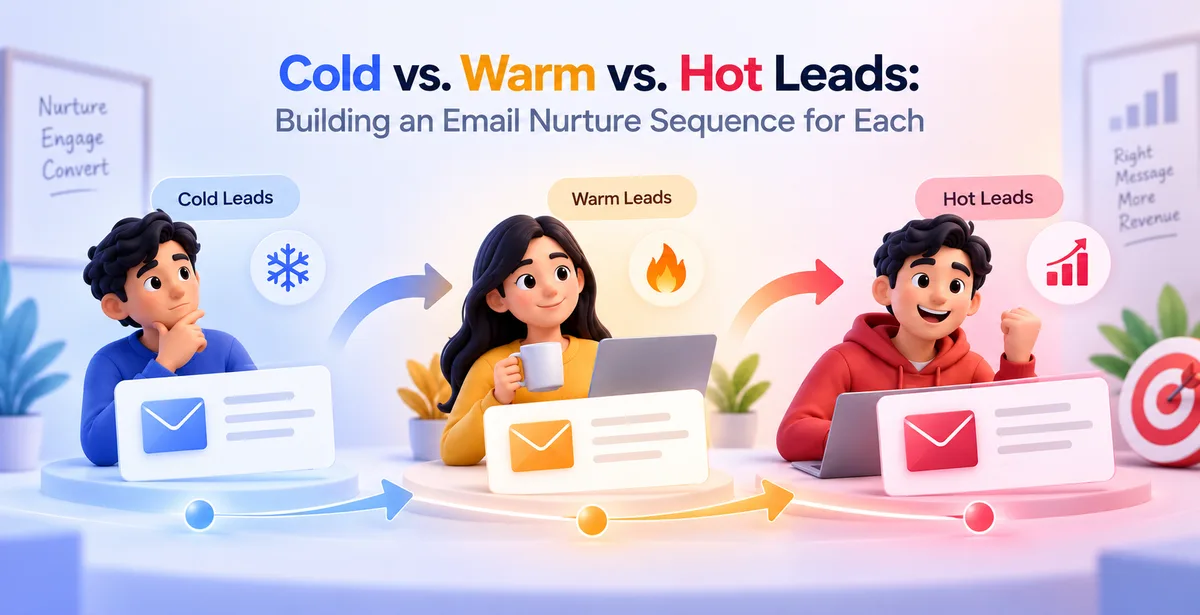
Hot (high score, recent activity) - open and click regularly. Give them early access, ask for reviews, and don't worry about emailing them a bit more often.
Warm (moderate score, some activity) - paying partial attention. Standard campaigns work fine, and this is the group to A/B test subject lines on.
Cool (low score, activity has dropped off) - used to engage and stopped. Good candidates for a targeted "we miss you" note or a different content type, before they slide further.
Cold (no activity in a long stretch) - worth one honest re-engagement attempt ("still want to hear from us?"), not a discount blast. No response means it's time to stop emailing them.
Dormant / suppress - unsubscribed, complained, or bounced. Remove them from future messages. Sending emails to addresses that do not want to receive them damages the sender's reputation; it works as a spam score that mailbox providers use to decide whether to deliver the message to the inbox or to the spam folder.
Where this usually goes wrong
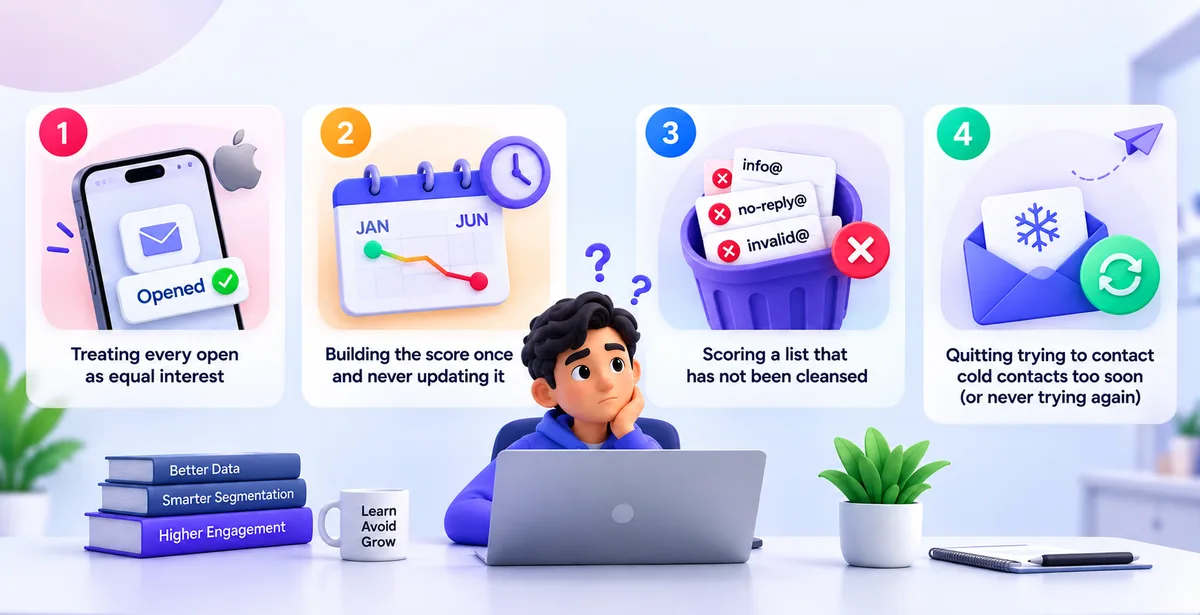
A few mistakes come up again and again when teams first try this.
The first is treating every open as equal interest, without accounting for how unreliable opens have become on Apple devices. A contact who "opened" ten emails through background image loading but never clicked once probably isn't engaged at all - they just have an iPhone.
The second pitfall is building the score once and never updating it again. The engagement is dynamic, and therefore the score should be flexible too. It may happen that someone was very engaged in January, but their score dropped significantly by June because their priorities have changed.
The third pitfall is scoring a list that has not been cleansed.If a chunk of your contacts are addresses that no longer exist, or role-based inboxes like info@ that no one reads, your engagement numbers are being skewed by addresses that were never going to engage in the first place. Verifying a list before scoring it is not an additional step but rather a prerequisite for the score having any meaning.
The fourth is quitting trying to contact cold contacts too soon, or never trying again. One wastes effort by pursuing people who will never answer; the other wastes contacts who might be persuaded with a different kind of email.
Putting this into practice
If you're using Pingovo already, most of the raw signals for a score are sitting in your account rather than needing to be built from scratch. The campaign dashboard tracks opens and clicks per contact, so you can see engagement at the individual level, not just as a campaign-wide percentage. The Email Health Score on the warmup side works on a similar principle in reverse - scoring your sending reputation the way you'd score a contact's engagement, based on signals like bounce rate and complaint rate.
For re-engagement, a follow-up sequence can be set up to trigger automatically for contacts who didn't open or click a campaign, so cool and cold segments get a win-back attempt without anyone manually pulling a list every week. And since a clean list is the starting point for any of this being accurate, running contacts through bulk verification before scoring them means the numbers reflect real people, not addresses that were never going to open anything.
A few quick questions people usually have
What is an engagement score in email marketing?
A score given to each of your contacts based upon their activity and engagement with your emails, calculated by opens, clicks, recency (how recently they engaged), purchases/replies. This list is then sorted based on this score which reflects their level of interest in you rather than demographics.
Is engagement score the same as open rate?
No. Open rate is a single campaign-wide percentage - what share of everyone opened one email. An engagement score is per-contact and looks at a pattern over time, not one metric from one send.
How often should engagement segments be updated?
Every two to four weeks works for most lists. Less often and the segments go stale; more often usually isn't necessary unless you're sending daily.
Should I stop using demographics altogether?
No - the two work together. Demographics decide what you send (a product category, a language, a location-based offer). Engagement determines who gets engaged first, how often, and when to stop engaging with someone who has stopped responding.
Demographics tell you who someone is. Engagement tells you whether they're still listening. A segmented list based on both will always beat one built on assumptions about age and job title alone, because it is based on what people are doing, rather than what they were when they signed up.