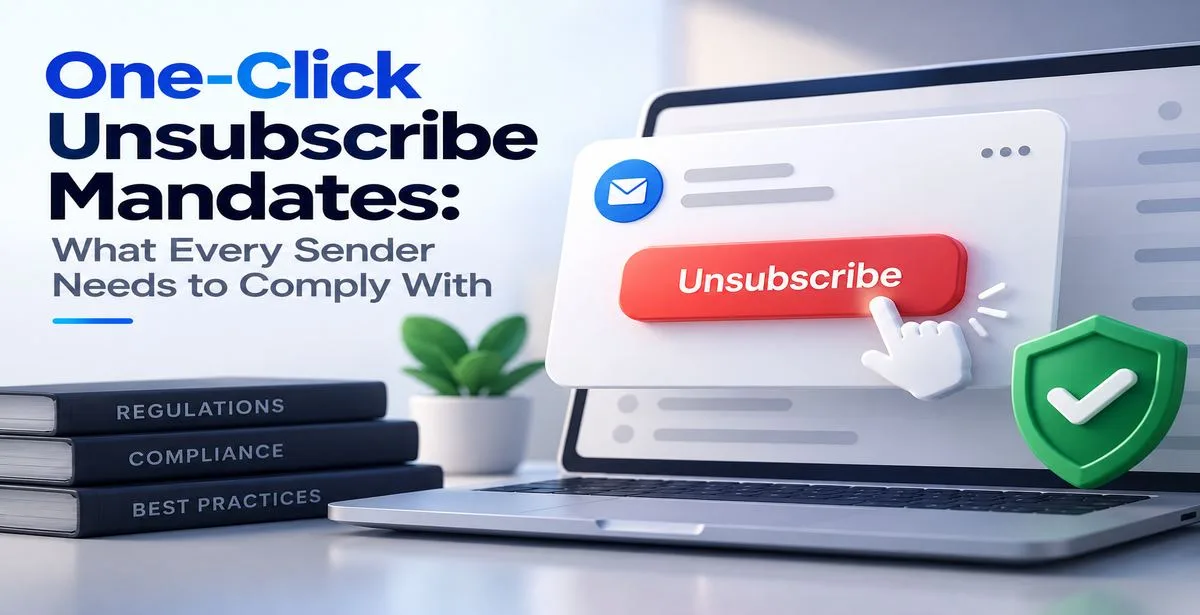
If you have sent a marketing email to a Gmail or Yahoo address anytime in the past couple of years you have already seen one- unsubscribe, at work whether you set it up yourself or not. There is a "Unsubscribe" link that shows up next to the sender's name before you even open the mail. One tap and the person is off your list. No landing page, no login no "are you sure you want to leave us" page with three buttons.
For senders this is not an UX touch anymore. Since 2024 Gmail and Yahoo requires this for anyone trying to send bulk email, if your emails don't support this correctly your emails could be going into spam or getting rejected all together. So let us go through what this rule means, who it applies to and what you need to check in your setup.
What one-click unsubscribe actually is
In other words , one-click unsubscribe means a subscriber can leave your mailing list in a click straight from their inbox screen without the mail even needing to open. Compare that to the way, where someone scrolls to the bottom of an email clicks an unsubscribe" text lands on your website maybe has to type their email again click a confirmation button and only then gets removed. Half the people give up somewhere in that process. Just hit the spam button instead which hurts you more than a clean unsubscribe ever would.
Gmail and Yahoo read the email through a rule (they don't look at your email design or your unsubscribe button at the bottom). If your email carries the instructions in its background code they show their built-in unsubscribe option in the inbox interface. This is separate from whatever unsubscribe link you have designed inside the email body. You need both and the inbox-level one is now compulsory for senders.
The part explained without the jargon
Every email has a "header," which is the background information that is attached to a message which you normally do not see things like who sent it, what server it passed through and so on. To enable one-click unsubscribe your email needs two lines added to this header:
- List-Unsubscribe – this tells the email provider where the unsubscribe request should go.
- List-Unsubscribe-Post – this tells the provider that the unsubscribe can be done with a click without opening a webpage.
This standard comes from a document called RFC 8058 (RFC just means it is an internet standard that companies agreed to follow, similar to how ISI marks work for products in India). You do not need to memorize RFC numbers to run an email programme though. What matters is that whatever tool you are sending from adds these two headers automatically and handles the removal on its own so you do not manually code this into every campaign.
Who this rule actually applies to
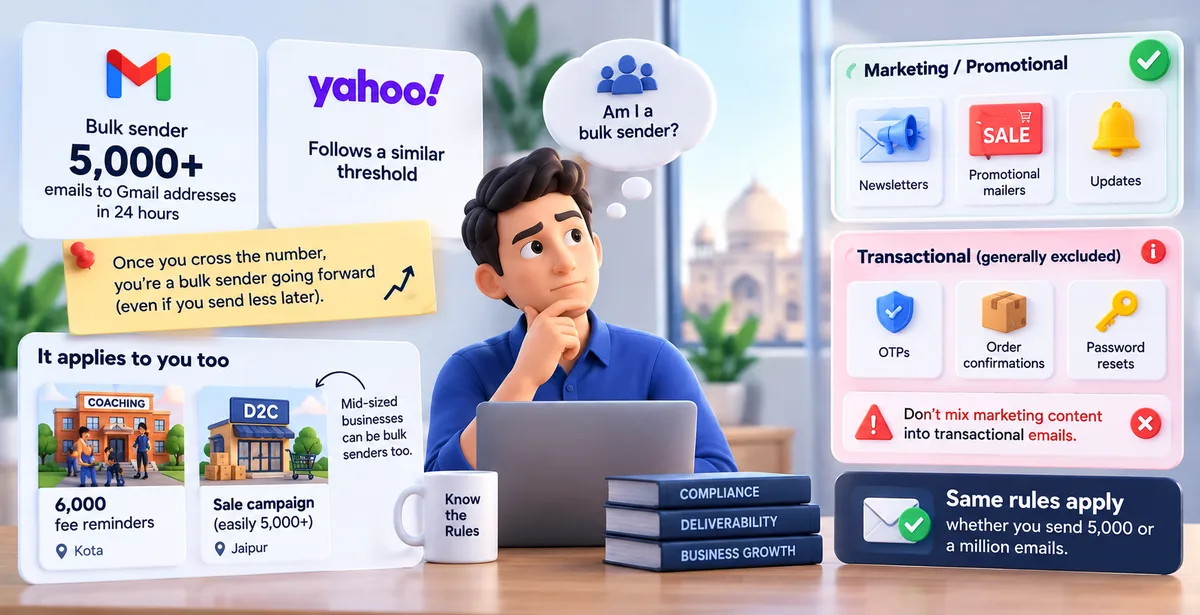
Gmail defines a " bulk sender" as any domain sending around 5,000 or more emails to Gmail addresses within a 24‑hour period. Yahoo follows a line. Once you cross that number once you are treated as a bulk sender going forward it does not reset the next day if you send less.
Here is where many mid‑sized Indian businesses get it wrong: they assume this rule is for large enterprises with huge lists.. 5,000 Emails a day is not a big number once you count newsletters, promotional mailers and updates together. A coaching institute in Kota sending out fee reminders to 6,000 students or a D2C brand in Jaipur doing a sale campaign could cross the threshold without realizing it. Once you are a bulk sender the same rules apply to you that would apply if a company were sending a million emails a day.
Transactional emails, like OTPs order confirmations or password resets are generally not treated the way as marketing or promotional mail under these rules.. If you mix marketing content into transactional‑style emails that distinction becomes unclear quickly. You should not assume you are exempt just because the email looks transactional.
What actually needs to be in place
Beyond the two headers mentioned above Gmail and Yahoo expect a few things from bulk senders and these usually come together as one package rather than separate boxes to tick:
The email domain you're sending from must be authenticated using three special DNS records. They're called SPF (specifies what servers are allowed to send messages on your behalf), DKIM (proves the message wasn't tampered with) and DMARC (tells recipient's server what to do in case of SPF or DKIM failure). Think of these as ID proof for your domain. Without them a receiving server has no way to confirm the mail genuinely came from you and not someone pretending to be you.
You also need to keep your spam complaint rate should be under 0.3%, ideally closer to 0.1 %. This is the share of recipients who click "report spam" of unsubscribing. If people cannot find a way to leave your list they mark you as spam instead. That hurts your sender reputation far more than losing a subscriber ever would.
Once someone unsubscribes through the one-click header the request needs to be honoured within two days. Not ten days, not " campaign cycle." If your system takes longer or the person keeps receiving your mail that counts as non‑compliance even if your headers were technically set up right.
Where the Indian angle comes in
If you are sending marketing email to people in India there is a layer worth knowing: the Digital Personal Data Protection Act (DPDP Act) which governs how personal data, including email addresses can be used for marketing. Consent for marketing communication needs to be clear and specific. People need a way to withdraw it whenever they want not buried three menus deep in a settings page. An easy unsubscribe is not just good for your Gmail deliverability anymore; it lines up with what Indian data protection rules expect
What happens if you skip this
Non‑compliance does not usually show up as one email bounce. It is quieter than that. Gmail started with errors for senders then moved to rejecting a growing percentage of non‑compliant traffic over time. In practice some of your emails simply never arrive, with no obvious error pointing you to the cause. Your open rates quietly drop and unless you are actively checking your sender reputation you might not connect the dots back to a missing header for weeks.
A few mistakes senders keep making
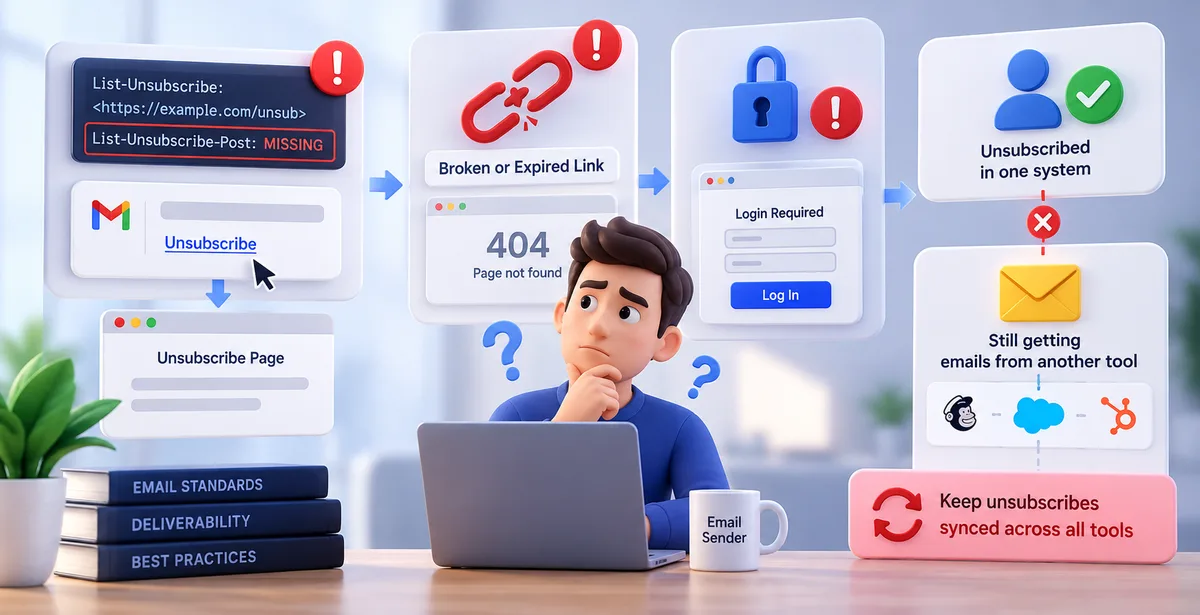
A common one is adding the List-Unsubscribe header but forgetting List-Unsubscribe-Post so the "one-click" part does not actually work; Gmail shows the link. Clicking it takes the user to a webpage instead of removing them instantly. Another is having the header point to a link that is broken, expired or requires login, which defeats the purpose. Some senders also unsubscribe the person in the header click, but continue to send them the newsletter separately, since 2 different systems do not communicate with each other. If you send campaigns from more than one tool, make sure unsubscribes are synced across them.
Checking where you stand
You do not need tools to test this. Send a campaign to a Gmail and a Yahoo test address. Look for the unsubscribe option near the sender name. Click it. See if you are removed instantly or redirected somewhere. If you can view the raw email headers (most webmail clients let you do this under something like "Show original”) check that both List-Unsubscribe and List-Unsubscribe-Post lines are present. If either is missing, that is your starting point.
This is also closely tied to your broader sender reputation since spam complaints bounce rates and unsubscribe handling all feed into how mailbox providers score your domain over time. This is where a platform like Pingovo becomes genuinely useful for senders who do not want to track all of this by hand. Its email warmup feature builds your sending reputation gradually before you scale up volume. The verification tool catches risky addresses before they turn into bounces that hurt your score and campaign tracking includes unsubscribe handling as part of the send so you are not stitching together systems to stay compliant.
The bigger point here
One-click unsubscribe is not really about a rule Google and Yahoo decided to enforce. It reflects something much simpler – people want control over what lands in their inbox and making it easy for them to manage means you build trust with your subscriber list than any smartly worded subject line ever will. Senders who treat this like a box to be ticked only and never revisit usually end up fixing it after the damage has already been done to their deliverability. Building it from the start alongside authentication and a genuinely warmed-up sending domain saves that trouble entirely.
Frequently asked questions
Is one-click unsubscribe mandatory for all senders?
It is mandatory, for bulk senders meaning anyone sending 5,000 or more emails a day to Gmail or Yahoo addresses. Smaller senders are not strictly required to have it. Gmail and Yahoo still treat unsubscribing as a best practice that affects inbox placement either way.
Does one-click unsubscribe replace the unsubscribe link inside my email?
No. You still need a visible unsubscribe link or button in your email body. The header-based one-click option is an additional, inbox-level way to unsubscribe, and both are expected to work correctly.
How quickly must an unsubscribe request be processed?
Within two days after the request Gmail and Yahoo’s current guidelines require action. If you take longer than two days or if you keep sending emails to a person who has unsubscribed the practice is seen as non‑compliance.
Do transactional emails need one‑click unsubscribe?
Generally no. These rules target marketing and promotional mail. However if a transactional email contains content it is safer to apply the compliance rules.
What's the easiest way to check if my emails are compliant?
Send a test email to a Gmail or Yahoo address. Look for the unsubscribe option, near the sender’s name. Verify that clicking the option removes you immediately without redirecting to a webpage or requesting login details.