Every list has them. The subscribers who signed up two years ago, clicked once, and then went silent. You keep sending. They keep not opening. At some point, someone from your team will suggest deleting all of them and starting anew.
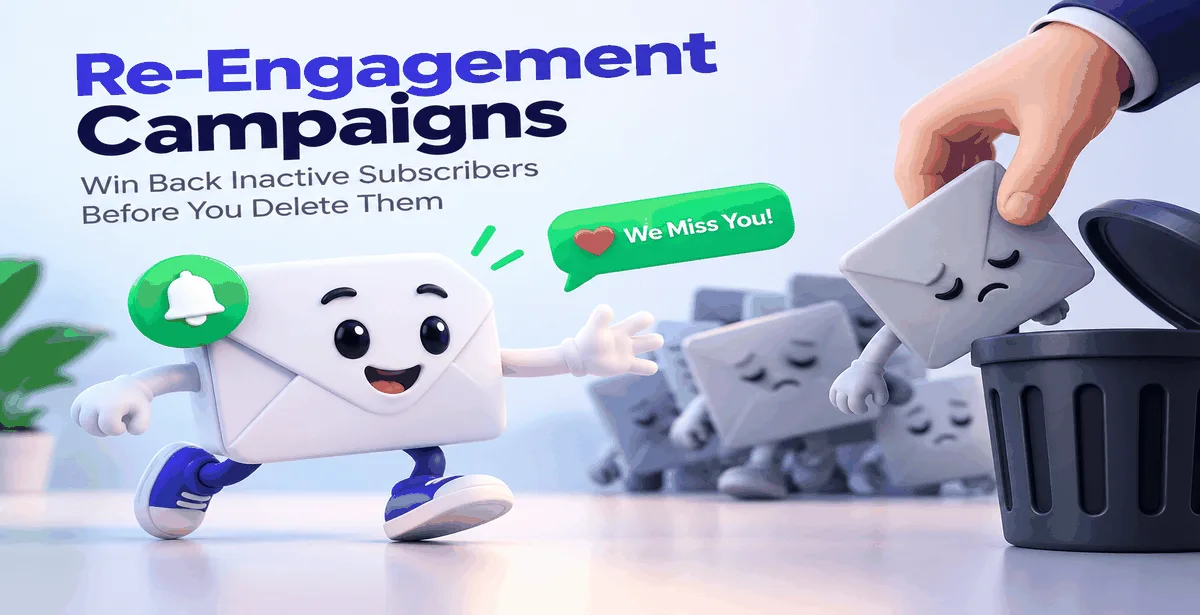
Before you do that, you need to understand why did your customers subscribed in the first place, and what short win-back sequence might rescue a fraction of them - since a re-engagement letter, cleverly worded, will almost inevitably recover more revenue than a simple deletion sequence
What counts as an inactive subscriber
There's no magic number here, and anyone who says "90 days" is the rule without looking 'at their own data is being ignorant. A weekly newsletter and a quarterly product update have completely different cadence's. If you're sending every week and someone hasn't opened in 60 days, they're likely gone, but if you're sending four times per year and 60 days has passed since their last open, they're probably not gone, because they simply may not have had a reason to engage yet.
A good heuristic for defining inactive users: look at their last three or five messages, and check if they opened none of them, clicked anywhere, and haven't been on your page/app/site in this period if you can track that. That combination - no opens, no clicks, no site activity — is a much stronger signal than open rate alone, especially now that Apple Mail Privacy Protection inflates open numbers for a lot of lists.
Why deleting first is the wrong order of operations
Here's the thing people miss: a subscriber who stopped opening your emails did not necessarily stop wanting your product. Life gets busy. Inboxes get cluttered. Sometimes people just forget they signed up. Eleting them immediately can be seen as treating disengagement as a permanent decision when it is often only a temporary one.
A friend who runs a small online store selling protein bars told me that she almost wiped 40% of her list because the numbers did not look good on paper. Before doing that, she ran a three-email win-back sequence offering a small discount and asking, plainly, if people still wanted to hear from her. About 9% responded by clicking through and purchasing something within two weeks. The remainder had not purchased anything but had opened the email for the first time in months. It was only after this process that she removed those who did not respond.
This is the order in which you should act to win clients back first and then delete those who have not responded.
What a re-engagement sequence actually looks like
There may not be a tried-and-true formula for every business, but most campaigns have some version of the same setup: three to four emails spaced out over the course of one to two weeks with each hitting your recipient on a slightly different angle.
The first email is generally the easiest - a gentle reminder that you actually exist, but without sounding too desperate. Something like "It's been a while" or "Did we lose you?" works better than an overly clever subject line, because the goal here is recognition, not cleverness. This email can be used to provide a snapshot value reminder, that is, inform about what the recipient has subscribed to, what has changed since, or a recent article or a product update.
The second email, sent three or four days later to whoever still hasn't opened, can carry an incentive if that fits your business — a discount code, a free resource, early access to something. This is also a good place to ask a direct question: "Are you still interested in hearing from us?"
The third email is the honest one. Tell them plainly that you're about to stop emailing unless they want to stay. Give them a one-click way to confirm they want to remain subscribed, and make it clear that doing nothing means they'll be removed. This email tends to get surprisingly good response rates, because people respond to a real deadline more than a vague "we miss you" message.
Some companies send out a short fourth email a few days later. It is brief: perhaps only the subject line and a sentence or two. It works (compared to the others) because it is unusual – different than the others.
Segmenting before you send matters more than the copy

One mistake many teams make is grouping the various inactive subscriber segments into one. There are typically at least two inactive groups which react differently to different messages.
Some subscribers were active once — they began to receive emails from you and interact with them for a long time, but then they just stopped being interested. Usually, such users begin to show signs of disinterest around a certain period — this means that they most often just stopped following you at one point. To re-engage them, you need to send a reminder email — short, mentioning what exactly they were interested in previously.
Other subscribers did not engage at all. They joined the list somewhere – filled out a lead magnet, a landing page, a hook – but never opened a single email. In this case, you cannot appeal to their possible interest in you or your community. A personalized message will not work for them either since they did not feel such interest. However, you can remind these people why exactly they subscribed to your newsletter. That is, repeat what you promised them. Appeal to the value you provided. Something like introducing yourself again.
For example, if your tool lets you create a multistep sequence that can be triggered by behavioral tags (e.g., launched a win-back campaign for people who didn't open your last 5 emails), then you can set it up once and forget about it, rather than having to run quarterly win-back campaigns manually. Pingovo's automation center is all about this type of setup: create the sequence once, tie it to a campaign, and let it continue to send out to anyone who didn't open or click on your messages, rather than having to do it yourself each time.
The part people skip: checking if the addresses are even real
Before initiating your win-back campaign, you might want to reconsider that list of inactive subscribers because a considerable amount of those emails may no longer be valid.People change jobs, abandon email accounts, or mistyped their address at signup and never noticed. The practice of sending out a win-back campaign to a list of invalid email addresses hurts the campaign by wasting it and potentially tarnishing your sender reputation because of spikes in bounce rates for that particular campaign.
Running the inactive segment through a verification check first, separating addresses that are simply invalid from the ones that are valid but just unengaged, makes the whole exercise more accurate. You end up sending the win-back sequence only to people who could plausibly still see it, and you get a cleaner read on how many genuinely chose not to respond versus how many were never reachable in the first place.
When it's actually time to remove someone
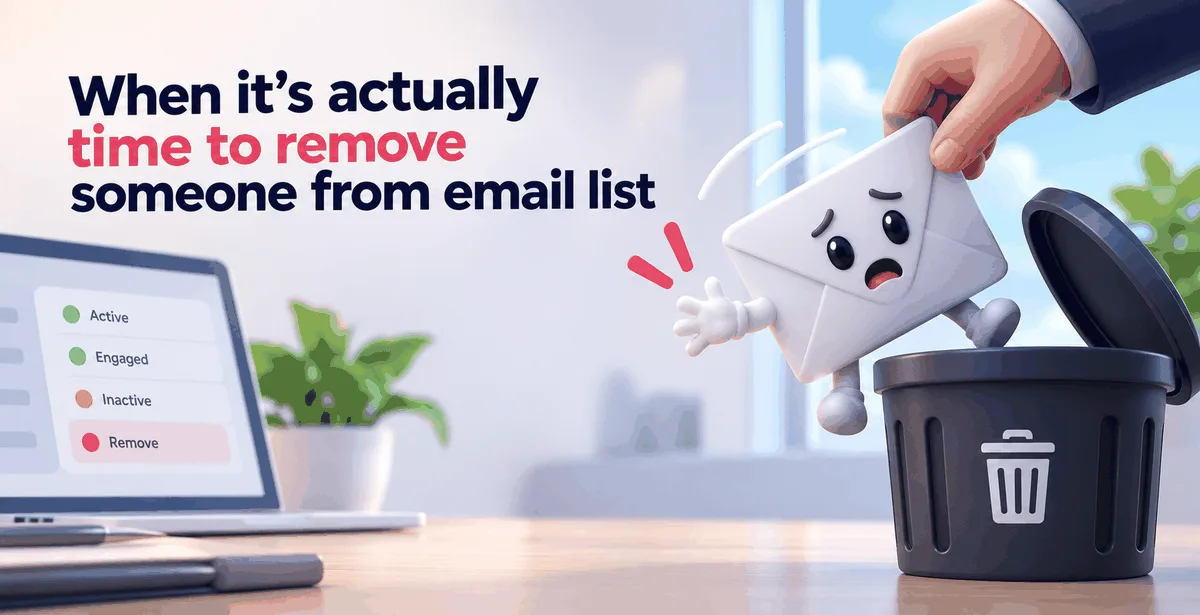
If a prospect has gone through a total win back sequence and has not opened, clicked or otherwise accepted to stay on board, it's a reasonable point to cut your losses. Holding on to unengaged addresses past this point mostly hurts you. Every email sent to someone who never opens is a data point that tells inbox providers your content isn't wanted, and that drags down deliverability for everyone else on the list too.
This is also where keeping an eye on your sending health helps, separate from any individual campaign. A warm, well-reputed sending domain recovers from an occasional bad segment much faster than one that's already struggling. If you are contemplating running a win-back campaign to thousands of old addresses, it is a good idea to look at your overall health score before doing so. If you have a low health score, it is probably not a good idea to send out a large amount of emails to your least engaged contacts all at once.
A quick example of how the numbers can look
A newsletter for freelance designers that sent out weekly emails had 22% of their mailing list not opening anything in 4 months. Rather than deleting those from their database, they sent a reminder email and a 'last chance to stay on the list' email 5 days later.Roughly 6% of the inactive segment opened and stayed. Approximately 3% of users have unsubscribed voluntarily. This is a positive metric, as the number of users who have received information is significantly higher than those who do not want it. Thus, the remaining 91% were removed.
That's not a spectacular win-back rate, and most re-engagement campaigns won't be.But recovering even a small amount of them, and removing the rest cleanly, will give you a list that is superior on all metrics that matter: open rates, click rates, and delivery performance in the long run.
The takeaway
Re-engagement campaigns aren't about saving every subscriber.They're about giving people a fair, disarming chance to say yes before assuming the answer is no. Some will return. Most won't. But running that sequence before deleting on sight is usually the difference between a short list and an effective list.