This problem happened a few years ago. When I first started helping companies with their email lists, I worked with a small events company who had about 40,000 contacts in their CRM. The marketing manager, Rahul, was convinced that he could run the whole database through a bulk verifier every quarter for a cost of about $1700 per year, which he believed would be good enough to save him money in the long run. Six weeks later after their big product launch email send, they still had a 9% bounce rate. Their email service provider sent them a warning and Rahul was confused as to why the tool hadn't worked for him. He called me puzzled, because he thought that he had bought a good tool.
The tool was fine and did what it said it would do. The error here was one of timing, not accuracy.
First, what's the actual difference
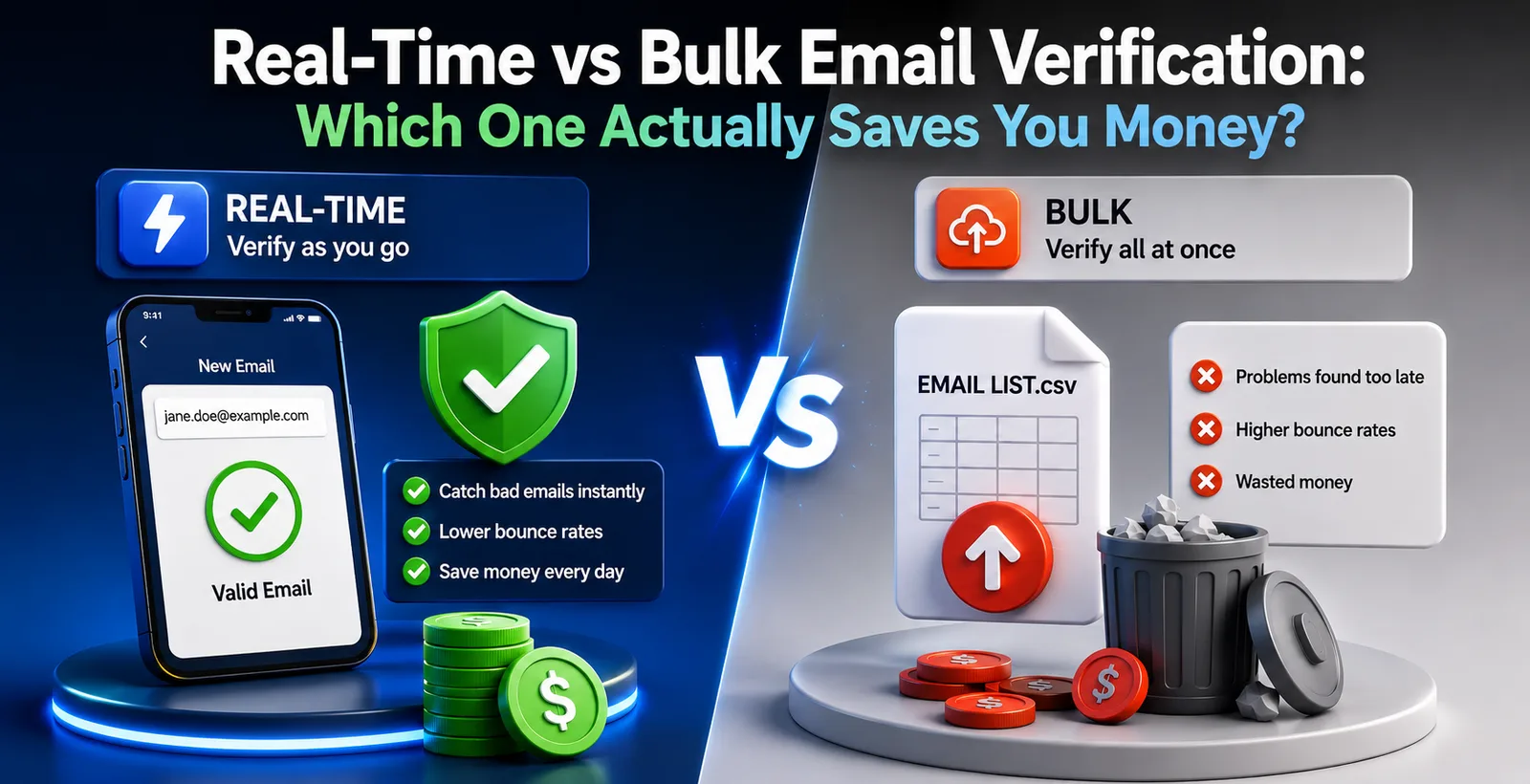
Bulk verification is a one-time cleanup of a list that you have sitting around on a schedule that you control. This means that it is better for old lists that have been gathered over time and have not been cleaned since. Bulk verification is best for lists that are not changing on a daily basis. If you have an old list of 50,000 contacts gathered over a year or two, this would be a good service to use.
The email is verified in real-time, which means before it's ever added to your database of current subscribers, the email is checked for validity (such as misspelled emails, disposable emails created to receive a single offer, etc.).
While both methods can achieve similar ends, their cost and value to you can differ dramatically.
 Where bulk verification actually earns its keep
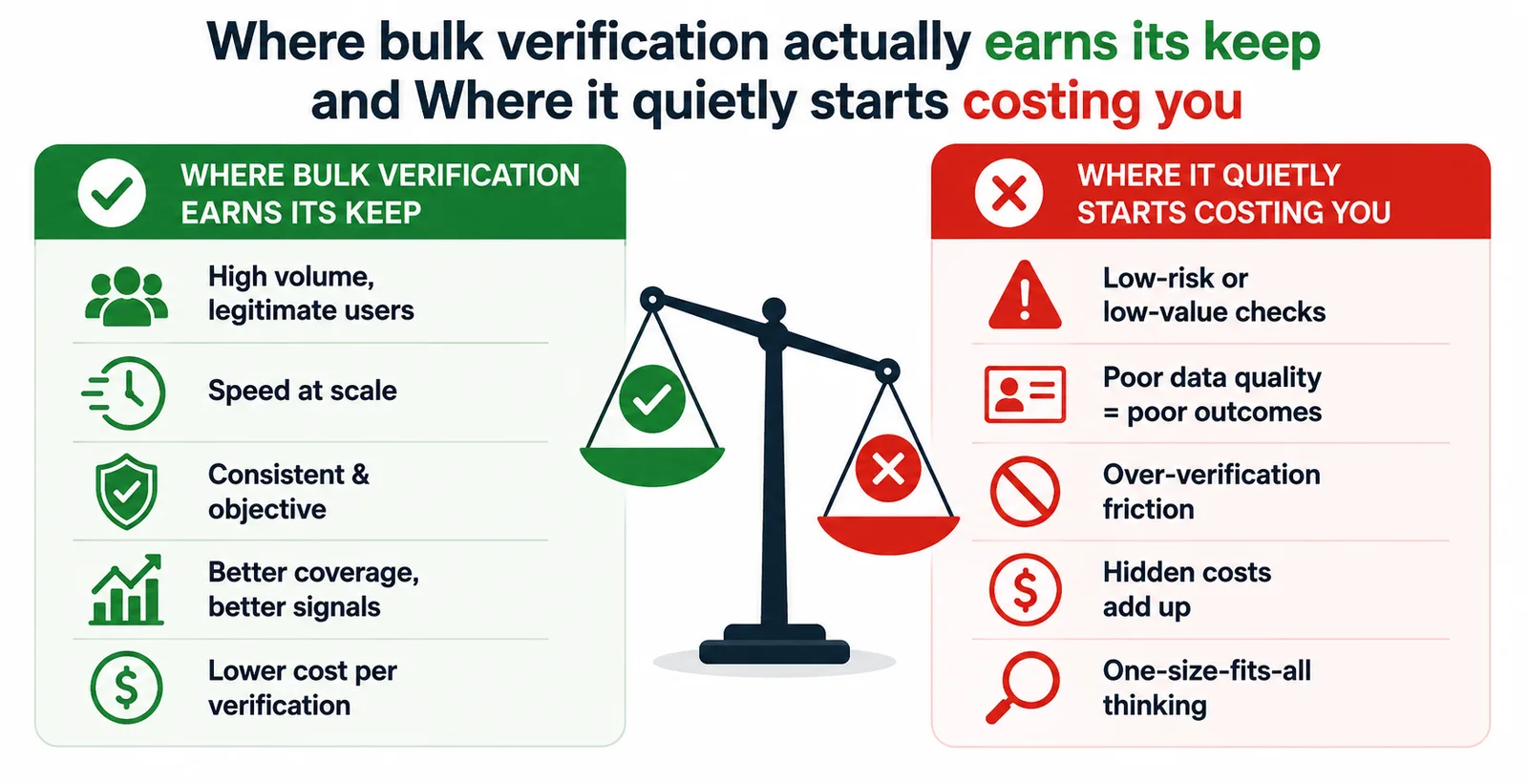
The bulk verification process is great for older lists that have just been sitting around collecting dust on an old CRM or that were purchased from a third party (please stop buying lists, it's just not good). Running a large list of existing contacts through a bulk verification tool will provide the fastest and cheapest way to clean up the list. For example, I worked with a fin-tech company called Northstar a few years ago. They had been collecting contacts for about 4 years from their webinars, PDFs gated behind forms, etc. Their list contained 180k+ contacts. We ran their entire list through a bulk verification tool for about $700 (based on the per-credit pricing at the time). After the cleanup, they had removed 31k of the bad addresses from their list. As a result of having a cleaner list of 149k contacts, their monthly bill with their email platform (which charges based on the number of total contacts on the list – whether active or not) decreased by about $260 per month. This wasn't a one-time savings, this was an ongoing savings every month after the initial verification.
So for stagnant lists, bulk verification pays for itself almost immediately.
Where it quietly starts costing you
In brief: Bulk verification only tells you what's currently broken, but not what will break in the future.
Each bulk verification run only clears up the errors in your current list. In the meantime, your signup form is still collecting typos, fake addresses and even so called "burner" email addresses. And this is collected on a regular basis. So, as you can see, a quarterly bulk clean-up is in fact mopping the floor while the tap is still running.
I previously explained how Rahul's events company was unable to get the email cleaning sorted for his signup form. The form had zero validation on it and as a result people where entering in gmial.com, [email protected] and even old work email addresses that where deactivated years prior. Rahul would perform a bulk email verification on a quarterly basis. This would clean up the list for 3 months and then the bad data would start building up again.
Why real-time changes the math
By checking an email address for validity before accepting it, real-time verification also prevents undeliverable emails from being added to your lists in the first place.
I have real-time verification set up for a mid-sized skincare company that runs paid online ads to a landing page for their sign-up offer. About 6% of the sign-ups for this company were undeliverable before I implemented the real-time verification. I have it set up so that it will catch misspelled email addresses as well as obvious fake sign-ups that try to sign up using a test email address in order to try to bypass the required field for first and last names. After implementing the real-time verification, the undeliverable sign-ups dropped to under 1%. Importantly, the ad spend for the online ads remained the same. Therefore, the real cost per lead for the leads that were actually deliverable dropped as well.
When you look at comparison tables, make sure to look beyond the cost per verification (e.g. 0.5c per email). Yes, bulk cleaning typically costs less per email than real-time verification. However, bulk cleaning only ever looks at a single point in time. Real-time verification protects your list quality continuously and also your sender reputation. Sending out spam in the wake of badly cleaned lists can cost you a lot more than the bulk cleaning. The cost for sending out these dirty lists can run into the tens of thousands of dollars, for just one campaign.
The pricing trap in the comparison itself
Stating that bulk verification is more cost-effective on a per email basis than real-time verification is somewhat true if one solely looks at the cost per verification. This would result in bulk verification being more cost-effective for one-time cleanups of large lists of subscribers.
But comparing cost per email between the two methods is somewhat misleading as it fails to account for the different types of protection each offers.
Bulk email verification protects your email list on a per verification basis and thus only at a single point in time. Real-time email verification on the other hand continuously checks and validates email addresses against up to date email servers in order to protect your email list and sender reputation from going wrong in the first place.
There's also a big difference between how providers track bounce rates and spam complaints and how that affects your deliverability. For example, if your bounce rate were to creep up to 2% or higher, then even 100% clean lists of real customers would experience degraded deliverability. And recovering from a damaged sender reputation can take weeks of very carefully warmed-up sending, during which time you'll likely see dramatically decreased open rates from all senders, including your own real customers and subscribers.
This goes back to how much a damaged sender reputation is going to cost you in terms of lost revenue over the course of a month? When most founders here think about the cost of verification they typically think about the cost of the actual verification but they don't factor in the cost of the damaged sender reputation over time.
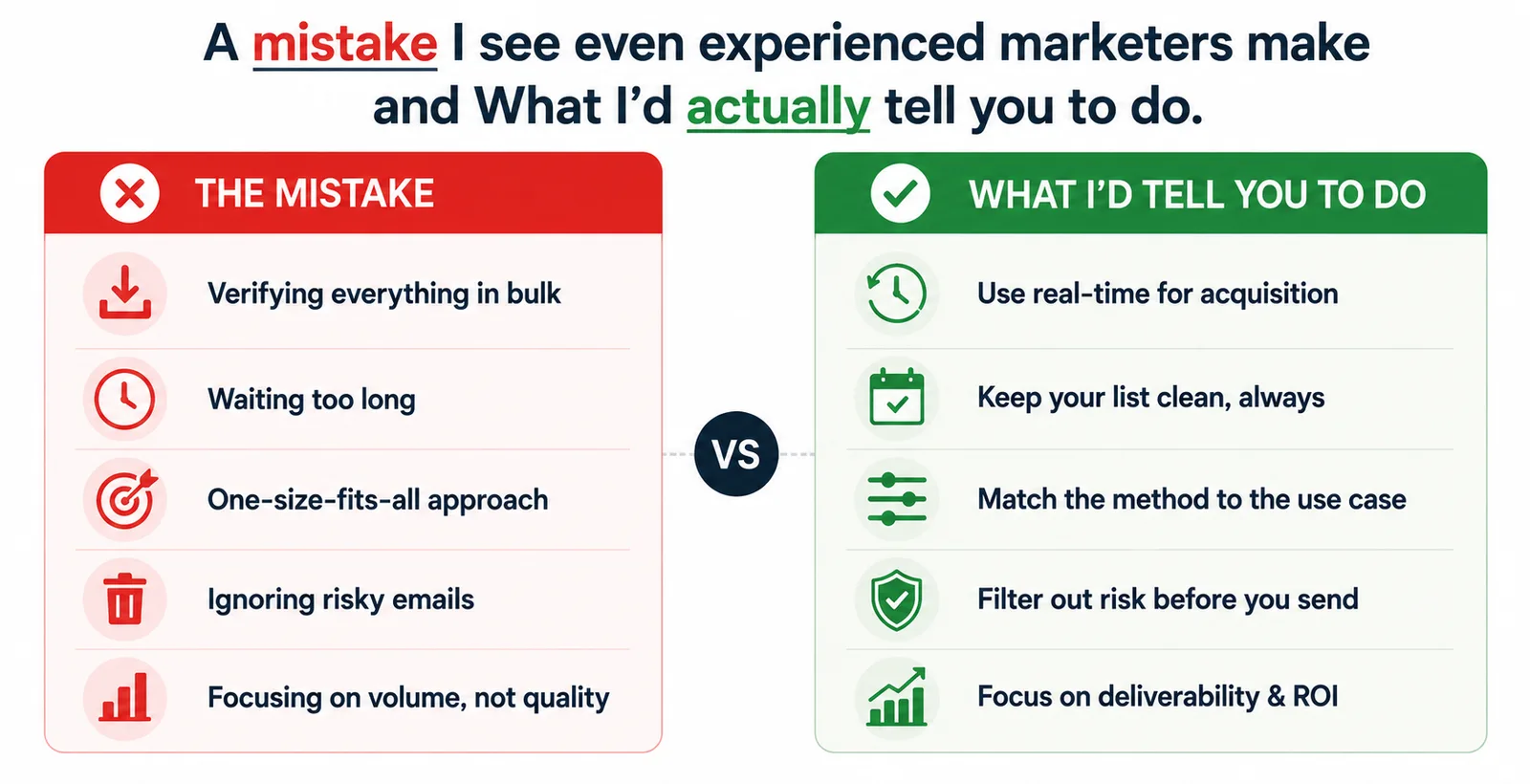
A mistake I see even experienced marketers make
There is a common misconception that a one-time list verification will keep your list clean forever. However, email addresses do decay, at a rate of up to 30% per year, and this is not just due to people changing jobs and thus switching email providers. A great many inactive email addresses are abandoned by people who simply stop checking their email accounts. This natural list decay is often greater for lists built for paid promotional activities (e.g. paid for ads, etc.) such as giveaways and contests, as well as for list signs-up on the sign-up form for a free trial or software download, etc. for a B2B company.
What I'd actually tell you to do
Run a bulk verification first if your list is old, static or if you are about to run a big campaign to a list of contacts that you haven't emailed in months. In these cases, it is more affordable to run a bulk verification for a one-time clean up of your list than to implement a service to verify your list in real time for ongoing signup forms.
A simple form (newsletter signup, free trial, waitlist, checkout) that people continuously fill out – in this case real-time verification is not a "nice to have" feature but rather insurance against bad data entering your system. Sure, the price per verification in such cases is often higher than in the case of bulk verification but it's still way cheaper than verification + cleanup.
In the end it is a simple matter of matching the right tool to the task at hand and allocating the right budget for each. In many cases, a company will have a backlog of email addresses that need to be verified before they can be added to a list for campaigns, and then continue to add new subscribers to the list through sign-up forms on a website for future campaigns. In these cases, a company will use a combination of bulk verification for the past and real-time verification for future sign-ups. I worked with the team at Rahul's events company to add real-time verification to their sign-up form for future subscribers.
I would say that for most companies, the correct answer to the above question is to use both bulk and real-time verification for different scenarios – the bulk solution for the one-time fix of past errors in their email lists, and the real-time solution for preventing future errors in signups to their lists for newsletters, free trials, waitlists and more that are online.
Rahul's team ended up implementing real-time checks for the form as well. Their next launch email had a bounce rate of 1.4%. No warning emails from the provider this time.
One last thing
If you've read this far, you're probably not looking for a tool that only does one half of the job. That's actually why we built Pingovo the way we did — bulk cleanup for the backlog sitting in your CRM right now, and real-time checks you can drop straight into your signup or checkout form, without stitching two separate platforms together or juggling two invoices.
You don't have to take my word for any of this either. Pingovo gives you a free batch of credits to test on your own list, so you can see your actual bounce and risk numbers before deciding on anything. If your list has been sitting untouched for a while, that's usually the fastest way to find out how much it's quietly costing you.