If you are running a business in India - a B2C skincare brand based in Mumbai, a B2B SaaS start-up in Bangalore, or a coaching business on your spare room in Lucknow - someone has probably told you to 'set up a drip campaign'.
But it's not that drip campaigns are a bad idea, it's that most people set them up with the automation in mind first and the actual reader second.
Let's fix that, from the basics.
What is a drip campaign, in plain words?
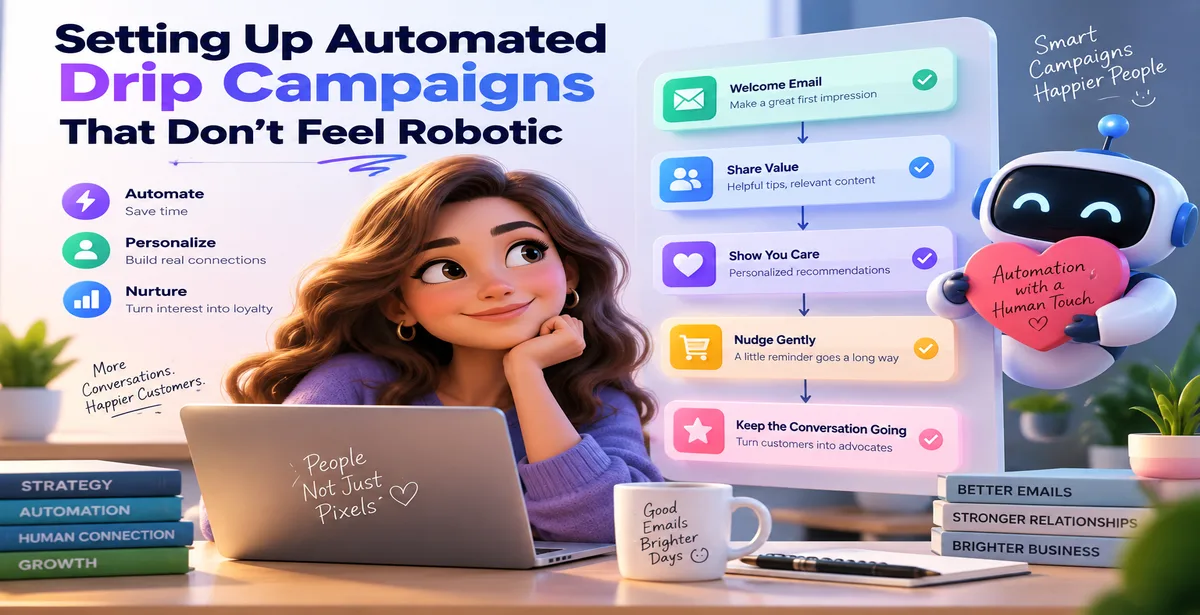
A drip campaign is simply a set of emails that go out automatically, one after another, based on a schedule or on what the person does. Rather than manually sending out fifty emails a day to fifty different leads, you can write the emails out once, set rules for when they should be sent, and let the software do the rest.
The term 'drip' comes from dripping water, slowly and steadily instead of all at once. So instead of sending all fifty of those emails you painstakingly wrote to your newest sign up at once, you space them out and send one email a day or when the recipient performs certain actions.
sounds simple, and technically it is. Where it goes wrong is in tone.
Why drip campaigns end up feeling robotic
"Robotic" here doesn't mean the email sounds like a machine wrote it. It means the reader can tell, within two lines, that it was never written with them specifically in mind. A few things usually cause that feeling.
The only personalisation in your greeting is the first name merge tag. 'Hi {FirstName}, have you thought about investing in your future?' could be sent out to a person looking to buy shoes, or a hospital - nothing in the subject line or body of the email gives away what the sender specifically wants you to think about.
Your trigger or cadence doesn't consider what the recipient has done or is currently doing. A customer who's bought from you already will continue to receive emails like 'Have you thought about buying yet?', and a recipient who's stopped engaging will continue to receive variations of the same email with slightly changed wording, even when they've marked it as spam.
Your writing style is trying too hard to be exciting. Email marketing writing is often chock full of exclamation marks and superlatives or words in”Amazing”, "don't miss out,". Your reader stops trusting the sender by the third email.
None of these are really automation problems. They're writing and strategy problems that automation just exposes faster — a bad email sent by hand to one person is a small mistake; the same email sent by a sequence to five thousand people is a pattern people notice.
Setting up the basics first
Before writing a single word of the actual emails, decide three things.
First, decide the goal of the sequence. A welcome sequence for new sign-ups has a different job than a cart-abandonment sequence, which has a different job again from a re-engagement sequence for quiet customers. Trying to make one sequence do all three is usually where the robotic feeling starts, because the emails end up vague enough to apply to anyone.
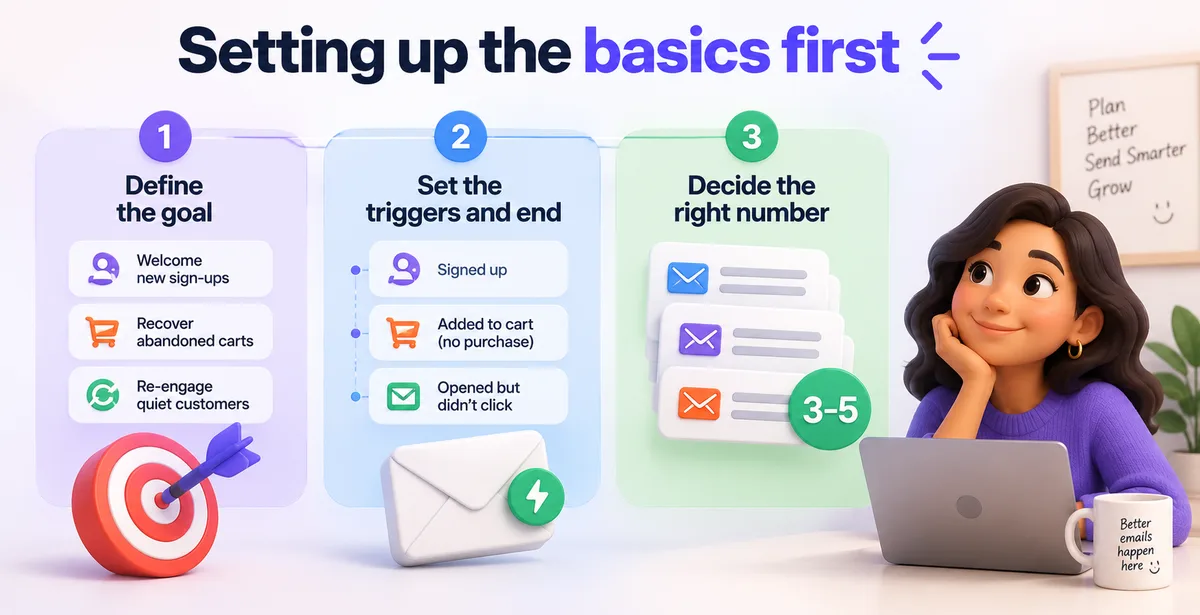
Secondly, decide what triggers the process and what brings it to an end – a trigger. For example, someone signed up to your newsletter; someone added a product to their cart but did not purchase it within an hour; someone opened your email but did not click – that is also a great trigger, it tells you they're curious but not convinced yet.
Third, decide how many emails it actually needs. Three to five is usually enough for most small businesses — a ten-email sequence that repeats the same point five different ways feels padded, and readers can tell.
Once those three are clear, write the emails like you're explaining something to one real person you know, not announcing something to a crowd.
The part most advice skips: what happens before the email is even opened
You can write the best drip sequence in the world that's perfectly timed, but if the email doesn't even make it to their inbox, it's not going to work.
A couple of technical things are worth understanding here, in simple terms, because they affect how trustworthy your emails feel to the people who do see them.
Sender reputation is the level of trustworthiness email providers (Gmail and Outlook, for example) assign to the sender’s email address or domain. New addresses and domains do not have any history, which email providers view with distrust, similar to a bank being cautious with an account that has no transactions yet.Mail from an unproven sender often lands in spam regardless of how good the writing is.
Email warmup builds that trust gradually, before real campaigns go out. Rather than a brand new domain blasting 2000 emails on day one, warmup emails in small batches, checking if the account is opened, replied or left alone and gradually increasing the quantities sent out until it's up to full blast. Pingovo's warmup tool does this automatically using a network of real mailboxes, and shows a health score so you know whether an account is cold, warming up, or ready to send at scale.
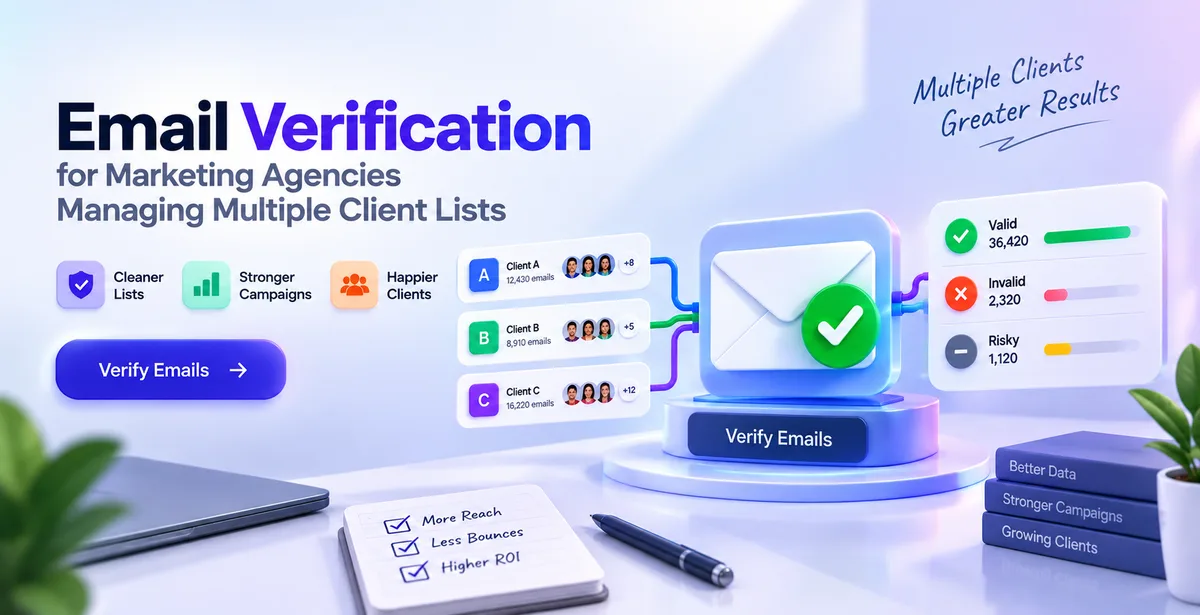
Email verification confirms an address is real and can actually receive mail, before you send anything to it. Old contact lists can accumulate addresses that were mistyped, abandoned, or even that never really existed in the first place, and bouncing messages to a list full of these addresses will damage your reputation nearly as much as spam complaints. To avoid this, running your list through a verification tool to check domains, mailboxes, and filter out disposable or role accounts such as info@ or support@ will keep your reputation pristine.
None of this is about clever subject lines. But it's exactly why so many drip campaigns feel like they're shouting into a void, or don't get read at all.
Writing the actual emails
Once you've got your process set up, there are just a few tweaks to make to your writing.
For every email, write as if it's the only one the recipient will ever see (and that they're not seeing in a series of 4 emails that make up a larger message). This small change will immediately improve your subject lines (no one is going to read "Following up on my last email" if they don't remember the last email) and your opening lines (which should hook the reader, not follow up on the last email).
Think about personalization. Name tag is the most minimum type of personalization you can think of. It's supposed to be the things a customer did, or what they viewed, what they added to cart, or which plan they are on. With Pingovo's campaign tool, you can personalize your subjects, images, and links for each customer, not just the name tag which makes all the difference between "Hey Rahul" and an email that reflects what Rahul did on your site.
Let the tone vary slightly between your emails, like how it would in a conversation, starting off warmer and more introductory and picking up to something a bit more direct when you're answering an objection. Otherwise, readers might get the sense that they're staring at a series of identical emails written by a robot.
Leave room for a reply. Write as though a real reply would be read and answered, because ideally it should be. Sequences that explicitly invite one, something like "just hit reply if this doesn't sound right," feel far less like a broadcast and far more like a conversation.
Timing that respects the reader
A drip campaign sent purely on a fixed schedule — day one, day three, day seven — while ignoring what the person does in between, is one of the fastest ways to feel automated. A better approach lets behaviour adjust the path.
If someone has clicked on the link in email two, that shows they've been interested, so you should be able to move onto the offer quicker. If someone has not opened up anything at all, sending them emails at the same pace is pointless, better to stop sending them for a little and then pick it up again, but with a new subject line. That's what makes the emails feel like they're not just a countdown to the next email, but something that actually cares about the other person.
A few mistakes worth avoiding
Sequences that never end are a common one. If someone converts, or opts out by ignoring each successive email, or replies asking to be unsubscribed, the sequence should recognize this and drop them off, rather than continue following a pre-set path to completion.
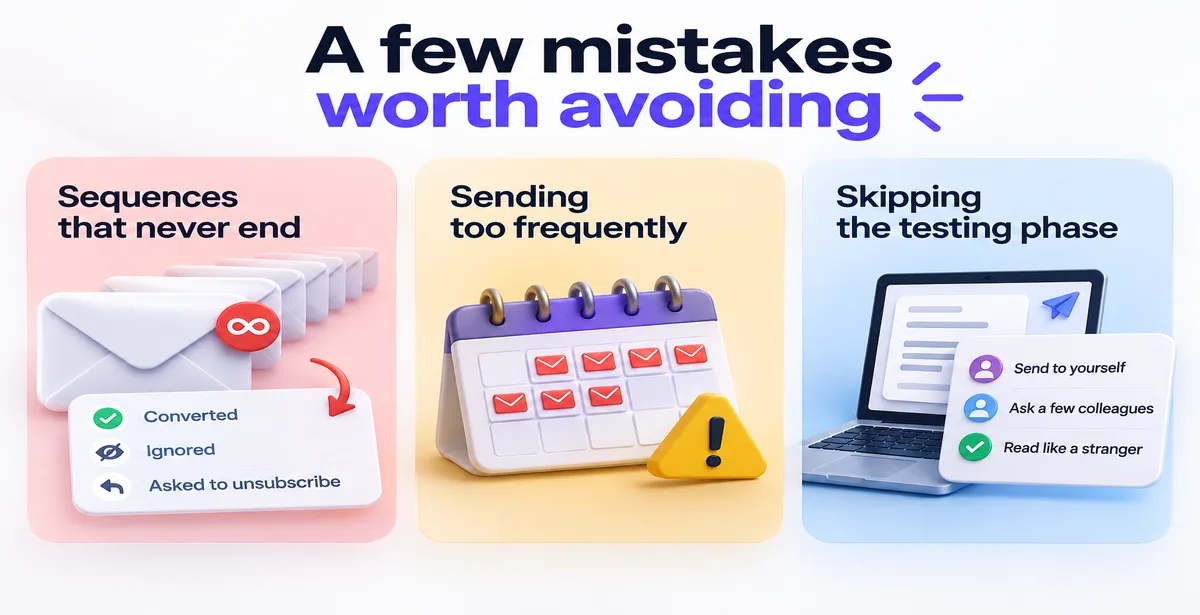
Sending too frequently in the name of "staying top of mind" is another. Daily emails for a week straight, for most businesses, reads as pressure rather than helpfulness.
Skipping the testing phase is a quieter mistake. Before sending to a full list, send it to yourself and a couple of colleagues spread across a few days, and read it the way a stranger would. Most robotic-sounding lines get caught this way — your own writing, read days later without the context of having just written it, shows exactly what a first-time reader would notice.
Quick answers to common questions
What is a drip campaign?
A set of emails sent automatically over time, either on a fixed schedule or triggered by what the recipient does — signing up, buying, or clicking a link.
How many emails should a drip sequence have?
Most small business sequences work well with three to five. The right number depends on the goal — a welcome sequence and a cart-recovery sequence don't need the same length.
Why do my automated emails end up in spam?
Usually because the sending account hasn't built enough reputation yet, or the contact list has too many invalid addresses. Warming up the account and verifying the list before sending both fix this.
Can a drip campaign be personalised beyond the first name?
Yes. Tools that support merge tags for subject lines, images, and links let you personalise based on actual behaviour, not just a name in a template.
Where this actually leads
A drip campaign that lacks robotic sound, is based not on clever wordplay, but on a carefully crafted sequence designed around the reader's specific requirements at each stage. It is sent out from an account that has built up a certain level of trust with the inbox providers, to a list of thoroughly verified, actual e-mail addresses.
Get that foundation right — a warm sending domain, a clean list, and a sequence with proper exits — and the writing becomes much easier since you don’t have to work against so many of the built-in challenges.